Tool review: Prusa Core One
Around a year ago I became a happy [Note: TL;DR: I like it!] owner of Prusa Core One.
Back then I was doubting if I should pay the Prusa/Made in EU tax, especially given in which state the company was: loudly complaining how being open source is hurting them, while conviniently forgetting to mention that instead of innovating they were trying to sell the version 7 [Note: Counting i3, MK2, MK3, MK3S, MK3S+, MK4 and MK4S. Hope I didn’t forget anything!] of the same bedslinger [Note: Prusa i3 came out in the year of our lord two thousand and fucking twelve!], while Chinese manufacturers were flooding the market with cheap and incredibly capable core-XY printers already. So after a year of heavy use I’d like to share some of my thoughts, and maybe convince you to pay the premium if you can afford it.
Disclamer: I use 3D-printing mostly for prototyping and/or mechanical parts, so I mostly care about very fast and dimension-accurate PLA printing, or printing engineering filaments such as glass or carbon fiber filled ASA, PET, PC, PPS, PA. Therefore this post overlooks niceties like INDX by virtue of them being quite useless for my usecase.
Meet the Hair Force Core One
So, the printer itself is rather sleek black box, with accent in already classical Prusa Orange
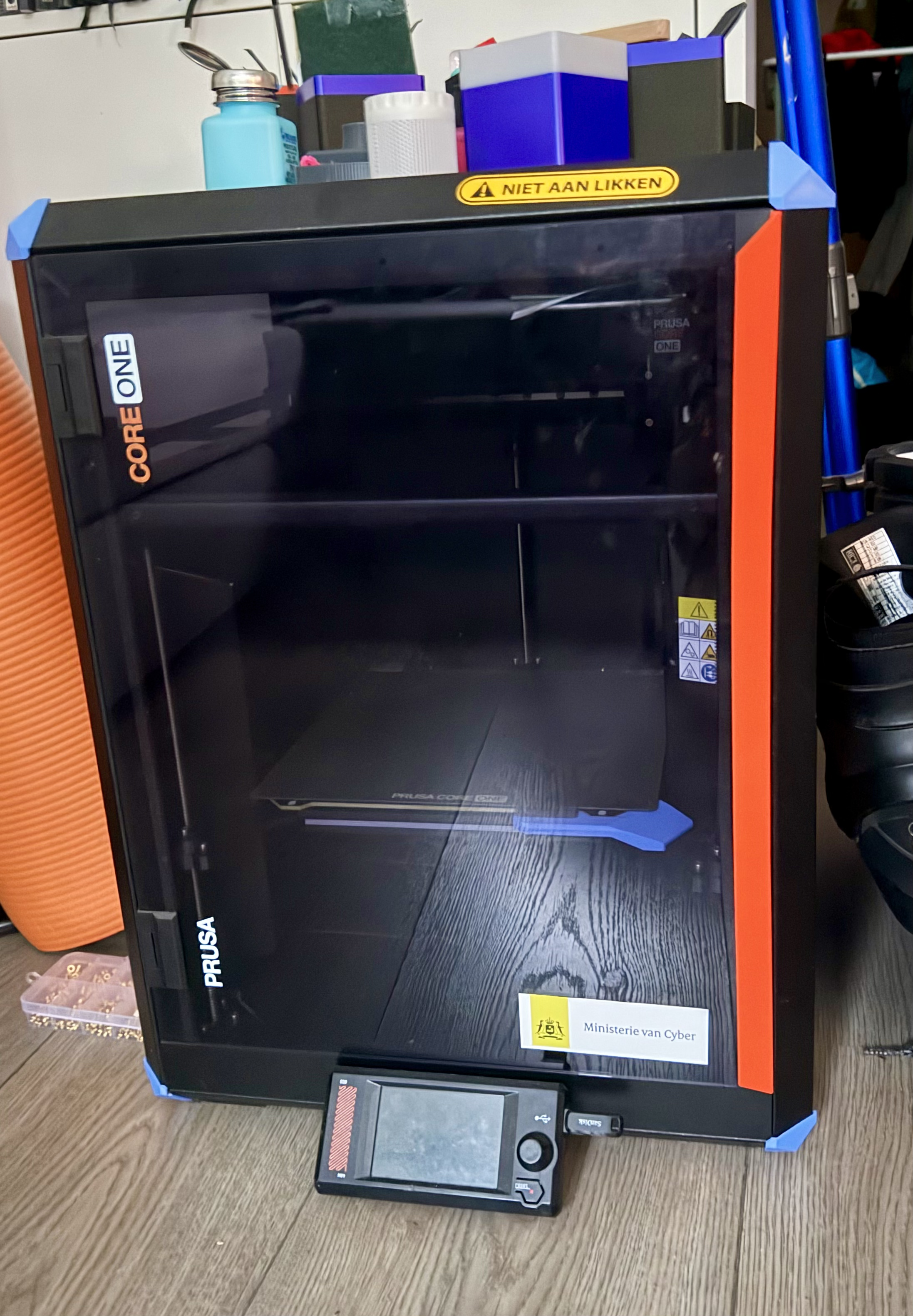
This one I ordered as a kit. While I could pay 300eur extra, this provides a nice weekend assembling lego [Note: But unlike lego, this is fun!] and also lets you get intimately familiar with the device at hand.
Honestly, during assembly I got hit with quite a bit of buyer’s remorse: back then the whole printer seemed like a feeble attempt at catching up with competition by reusing the latest of 2012 technology [Note: This post documents events that happened in 2025, full 13 years later]: printer is full of 3D printed parts [Note: Forget about filaments requiring high chamber temperature without replacing all of them!]. Prusa’s patented “self tapping machine screw” technology is still widely used all over the place. Where competition is using carbon fiber and light rods the Core One still needs to push around a piece of aluminum extrusion with a hefty extruder. The bed is still the same PCB DC-heater from i3, so warm up takes forever and the build volume comically small compared to the outside of the printer. All the plexiglas panels are held to the frame by nylon rivets. The door handle came in factory pre-bent. So first impression was not so rosy.
Especially with Core One L being released couple of months after I bought my Core One, I felt cheated tbh. L feels like an actual purpose build core XY printer, while Core One just like a something they threw together in a weekend from i3 parts [Note: While still charging you a thousand bucks for it!] after understanding that industry moved on without asking them.
Slow but Steady Redemption
Couple of test prints later my opinion is changed quite a bit: printer was delivering both quality and acceptable speed, and not so fast PLA printing speed problem could be solved by actually calibrating the filament. [Note: Here’s another annoyance, Prusa still refuses to ship slicer that supports calibration, so all the filaments have to be calibrated in Orca using worse printer profile supplied with it and then transferred and tuned in Prusa slicer, where you get latest and greatest profile from prusa]
Printing fiber-filled engineering filaments turned out not to be anywhere close to excellent, but quite OK: inability to reach high chamber temp bakes in quite a lot of stress in e.g. PCCF parts, making them nicely warp after they are removed from the bed. [Note: Which is typically resolved by some creative slicing] Waiting for printer to reach chamber temp is also painfully slow, but to be expected with 12V DC bed as heat source and no active circulation system.
But my plastic shitter [Note: Yep, that his name] was happily shitting out high-T, fiber filled plastic parts: props for Prusa shipping hardened high flow nozzle from day one, as well as building an outstanding extruder. Assembling the nextruder was the highlight of the process tbh: everything fits like a glove, there’s easy access to everything while extruder is on the machine. Nylon rivets are easy to remove, so the whole top panel can come off to get an easy access to the whole “drivetrain”. [Note: Still would have preferred to see screws there] In the year of owning it and printing quite heavily I didn’t have a single mechanical problem with this printer.
Still a User-Aligned Company
Even with all the bitching and whining about “opensource bad, we can’t sell a 700eur i3 anymore!” Prusa is still aligned with their customers and not with the shareholder value, which is quite refreshing to see in our modern enshitiffication cyberpunk dystopia. While people gave them a lot of flak for changing the license to OCL, IMO this flak is completely undeserved. This is one of the few companies that still gives you full Fusion and STEP model of the printer. Qua hardware: whatever modification you want to make - all the tools and information are there for it. Qua software: you just need to break off a small piece of PCB [Note: Yeah, I also find this approach as too paranoid tbh, a simple solder bridge should be fine] to run whatever firmware you want on it. This results in a metric shitton of mods and fixes for annoyances provided by the community: want more stable chamber temp? Here’s some plugs for the corners and a set of backdraft shutters for the exaust, couple of hours of printing later and problem is fixed. You do not want to clean the nozzle by hand like a dark age peasant? Here’s the mod to attach bambu compatible wiper with a handy G-code generator. While already mentioned bambu also has a healthy modding scene, prusa still gives way more tools for community to fix their printers. [Note: Not to mention just evil firmware fuckery that bambu pulled couple of years ago]
Another highlight: Even though I still believe that Core One is an MVP slapped together not to go bankrupt, Prusa still supports it as an actual Prusa product. There were two upgrade packages brought out already, in a form of “buy or print yourself”, quite often inspired by the community mods. When early users were complaining about the VFA problems [Note: Which were not mentioned before because first, my unit didn’t had them, second, I don’t give a flying fuck about aesthetic 3D-printing] Prusa did quite a bit of firmware work and in the end brought out a belt upgrade. Even though it gets delayed season after season we might finally get a 400 degree hotend this year, so printing real plastic becomes less precarious.
Should You Buy a Prusa in 2026?
Well, it depends :). For printing engineering filament something like a qidi is definitely cheaper and better platform to get yourself up to speed, but then you are on your own. Something like top-of-the line bambu is better as a printer, but they have a history of fucking users over and also no user serviceable parts inside.
So yeah, in my opinion if you can afford it - Core One is a very good tool, and you get your ROI via long term support and service by the company. I’m honestly excited for core three or four, as long as prusa doesn’t slip into their old habit of “lets try to sell the same printer for the next 15 years”.